
 Available in US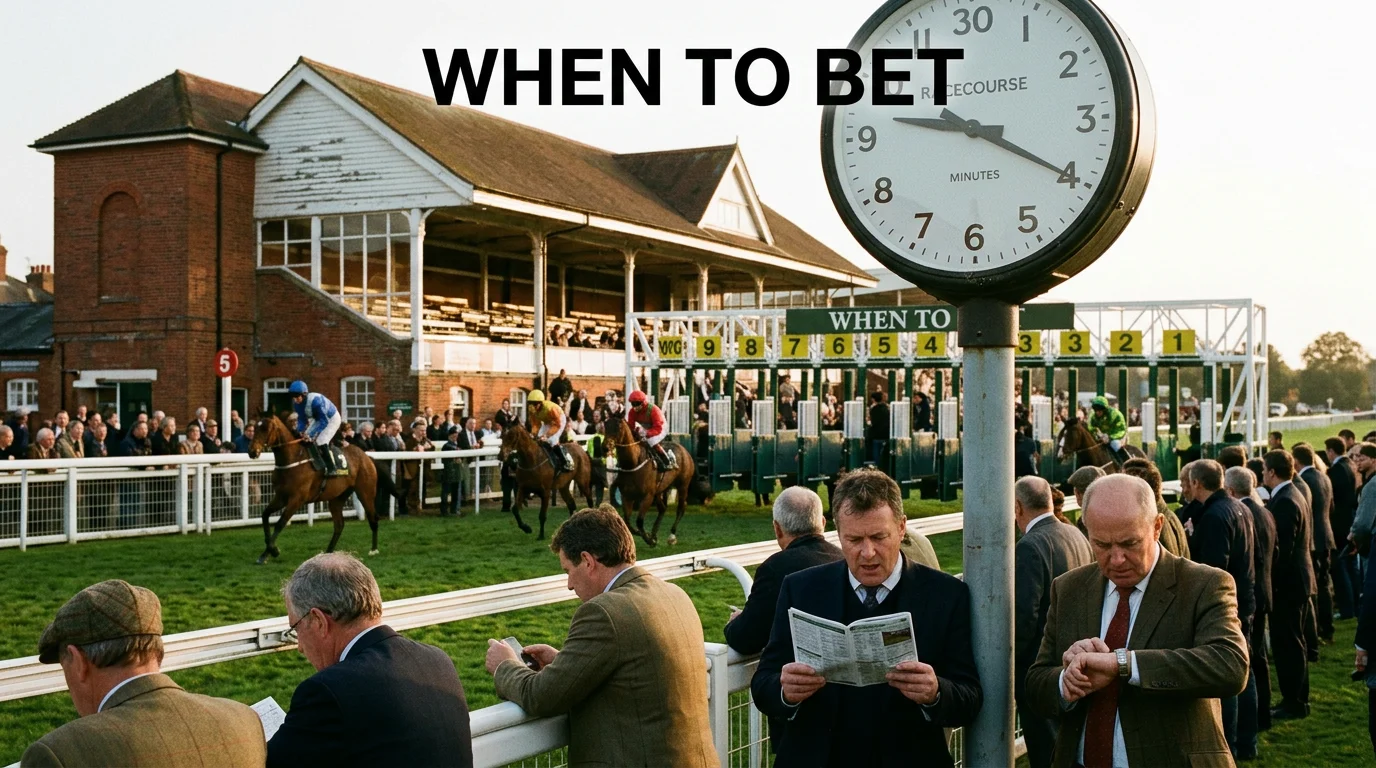
Contents
The decision of when to place your exacta bet shapes both the price you receive and the certainty you enjoy. Exacta betting timing involves trade-offs that experienced punters navigate deliberately rather than leaving to chance. Bet early and you lock in a position before late money shifts the pool. Bet late and you gain information—confirmed runners, market sentiment, final pool composition—that early bettors lack.
Pari-mutuel wagering creates these timing dynamics because the dividend isn’t fixed at bet placement. Your exacta payout depends on the final pool composition after the race concludes. An exacta combination that looks generously priced at morning odds may compress as money arrives closer to post time. Conversely, combinations overlooked early sometimes drift to value as the market focuses elsewhere.
Different race types and meeting profiles reward different timing approaches. A midweek afternoon handicap behaves differently from a Championship race at a festival. Understanding these patterns helps you choose when to commit your stake. Time your bet, time your edge.
More pool betting strategies at exacta box bet.
How Pools Evolve Pre-Race
Exacta pools build gradually from market open through post time. Early morning, indicative dividends displayed on betting platforms reflect minimal actual money. A few larger bets can dramatically shift these indicative prices, making early readings unreliable guides to final value. The pool is thin, the probables are volatile, and serious conclusions remain premature.
As race time approaches, money flows accelerate. The final thirty minutes before a race typically sees more pool activity than the entire preceding period. Professional bettors, on-course punters, and casual recreational money all concentrate in this window. The pool depth increases, indicative dividends stabilise, and probable payouts become more predictive of final outcomes.
The transformation can be dramatic. On major World Pool fixtures, most racedays amass over HK$300 million (approximately £29 million) in turnover. That liquidity materialises primarily in the final stages before post time. An exacta combination showing £200 probable in thin early markets might settle at £80 once genuine volume arrives. The reverse happens too—combinations attracting little early interest sometimes offer better final value than their indicative prices suggested.
Pool composition also shifts. Early money tends toward obvious combinations involving market leaders. As betting progresses, more nuanced money—professional punters exploiting specific edges, locals with course knowledge, syndicate activity—enters the pool. These later flows often introduce volatility that reshuffles probable payouts. The early market reflects casual opinion; the final market reflects serious money.
Non-runner declarations complicate pool evolution further. UK racing permits non-runner declarations until relatively close to race time. A key selection withdrawing late changes everything: the exacta combinations involving that horse become void, stake money returns, and the remaining pool recalculates around a reduced field. Betting early carries withdrawal risk that late bettors avoid entirely.
Advantages of Early Betting
Early betting captures value before the market efficiently prices it away. If your analysis identifies an overlooked combination, placing your bet before wider recognition develops locks in that value. Late money agreeing with your assessment actually helps you—the final pool includes your bet at the earlier, more generous implied price, and additional volume doesn’t diminish your return.
Pool influence matters more in smaller meetings. On a thin Tuesday card, your exacta bet constitutes a meaningful fraction of the total pool. Placing it early prevents your own stake from compressing your probable dividend. If you wait and bet late on a thin pool, your money moves the market against itself. Early placement avoids this self-inflicted dilution.
Psychological benefits accompany early betting too. Once your position is established, you can watch the race without the distraction of last-minute decision-making. The temptation to second-guess selections, add horses, or modify stakes disappears. Your bet is down; your analysis is committed; your remaining job is simply to watch the race unfold.
Calendar predictability favours early bettors planning festival campaigns. If you’ve allocated specific bankroll for Cheltenham exactas and identified target races weeks in advance, placing bets early in the day—or even ante-post for major races—lets you execute your plan without fighting race-time crowds or suffering platform delays during peak traffic periods.
Advantages of Late Betting
Information accumulates as race time approaches. Late bettors see the final declared runners, eliminating withdrawal risk. They observe market movements that reveal where serious money is landing. They gauge final pool size and composition. This informational advantage allows more refined decision-making than early betting permits.
Pool visibility reaches maximum clarity in the final minutes. The UK Tote displays live pool totals and indicative dividends that update continuously. Watching these figures stabilise tells you what combinations the market is supporting and which remain overlooked. Value hunting becomes possible with actual data rather than speculation about how the market might develop.
Late betting enables responsive strategy. If your preferred combination has attracted heavy support and the probable dividend has collapsed, you can redirect stake to better-value alternatives. If an expected withdrawal hasn’t materialised, you can proceed with confidence. If track conditions change dramatically due to weather, late bettors can adjust selections accordingly. Early bettors are locked in regardless of developments.
The UK Tote’s 25% deduction from the exacta pool means you need genuine edge to profit consistently. Late betting maximises your ability to identify and exploit that edge. Seeing the final market shape—which combinations are over-bet, which are overlooked—lets you target inefficiencies rather than hoping they exist.
Major meetings particularly reward late assessment. The volume and sophistication of money on championship races means early prices often fail to predict final dividends accurately. Waiting allows the market to reveal its true shape before you commit resources.
Timing Strategy by Race Type
Different race profiles suggest different timing approaches. Understanding when early betting makes sense and when late betting offers advantages helps you adapt your strategy across the daily card.
Competitive handicaps with large fields generally favour late betting. These races attract diverse opinion, significant pool activity, and meaningful price movement throughout the market. Probable dividends fluctuate substantially as different combinations gain and lose support. Waiting until the pool stabilises reveals where value actually lies rather than where you hope it might be.
See also: flexi betting exacta — smaller stakes with flexi betting on exactas.
Small-field conditions races behave differently. With limited runners and clearer form hierarchies, market consensus forms earlier and remains stable. The likely first and second are obvious; dividend variation comes from how the remaining possibilities are weighted. In these races, early betting carries less informational disadvantage because the market has less complexity to resolve.
World Pool fixtures introduce cross-jurisdictional dynamics. When UK races commingle with Hong Kong pools, substantial Asian money arrives in final minutes, often favouring particular trainers or jockeys based on overseas reputation. A UK punter betting early on a World Pool race lacks visibility into how Hong Kong money will reshape the final pool. Waiting provides clarity on where international money is landing.
Midweek cards with thin pools present unique considerations. Your own bet moves these markets more noticeably, and late betting in thin pools can push your probable dividend down through self-influence. Early betting in these scenarios—placing your stake before watching it dilute the very value you’re pursuing—sometimes makes practical sense despite the informational sacrifice.
Festival racing combines high-stakes decisions with premium pool depth. Cheltenham, Ascot, and Aintree offer exactly the environment where late betting excels: deep pools, sophisticated money, meaningful price discovery in final stages. Plan your selections in advance, but delay execution until the market reveals its hand. The competitive advantage of late information outweighs any value captured by early positioning.
